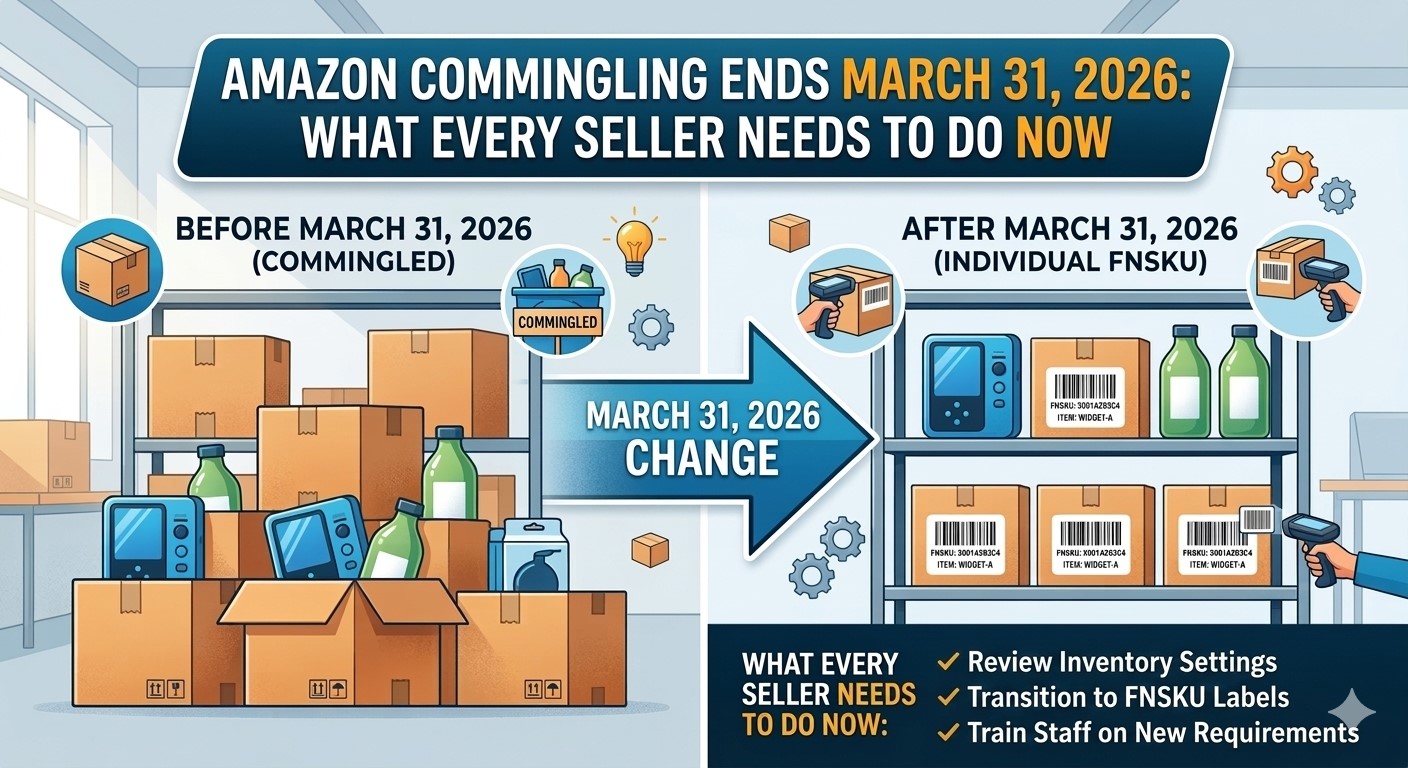
Amazon's stickerless commingling program ends on March 31, 2026 — just days from today. The impact is not the same for every seller. Depending on your seller type and whether your products carry manufacturer barcodes, the change could mean almost nothing, or it could require you to rework your entire inbound workflow before the deadline.
What Is Commingling — And Why Is Amazon Ending It?
Commingling, formally called stickerless commingled inventory, has been part of Amazon's fulfillment network for over a decade. Under this system, Amazon fulfills customer orders using the closest matching unit across all seller inventory — regardless of which seller actually sent that unit in. Two sellers shipping the same product with the same manufacturer barcode (UPC, EAN, or ISBN) would have their inventory pooled together in Amazon's fulfillment centers, with Amazon picking whichever unit was closest to the buyer to maximize delivery speed.
For sellers, commingling had a practical benefit: it eliminated the need to apply FNSKU labels to every unit. Products could be shipped to Amazon using their existing manufacturer barcodes, saving significant time and cost, especially for high-volume resellers and online arbitrage sellers.
But commingling also created persistent problems, especially for brand owners. Commingling units from different sellers creates a single pool from which to fulfill. So, a customer who ordered from a reputable seller could receive a unit sent in by an entirely different seller - including one containing counterfeit, expired, or damaged goods. Brands had no way to trace quality issues back to the responsible seller. The problem became significant enough that major consumer brands temporarily withdrew from Amazon, citing inability to protect product integrity.
The announcement to end commingling came at Amazon's annual Accelerate seller conference in September 2025 and reportedly drew more applause from sellers than any other policy update of the event. The announcement was subsequently communicated through Seller Central. Amazon's stated reason: advances in logistics network density and inventory placement technology now allow fast delivery speeds without the need for pooled inventory. Amazon specifically noted that brand owners spent an estimated $600 million in the prior year alone on re-stickering products — applying FNSKU labels purely to opt out of commingling. That cost is now eliminated for qualifying brand owners.
What Changes on March 31 — By Seller Type
The policy change does not affect all sellers equally. Your situation after March 31 depends on three things: your seller type, whether you are currently using the commingling program, and whether your products carry a manufacturer barcode. The table below maps all six scenarios. If you are a reseller currently using stickerless commingling, this change requires your immediate attention as shown in the table below.
| Seller Type | Using Commingling Now? | Manufacturer Barcode on Product? | Current Scenario | Post Commingling End | Attention Required? |
|---|---|---|---|---|---|
| Brand Owner Brand Registry — Brand Representative role | Yes | Yes (UPC, EAN, ISBN) | No re-stickering - selling via manufacturer barcode using stickerless commingling | No change. Continue selling under manufacturer barcode. | No action needed |
| Brand Owner Brand Registry — Brand Representative role | No | Yes (UPC, EAN, ISBN) | Applying FNSKU labels to opt out of commingling | May switch to manufacturer barcode if preferred, or continue using FNSKU. Either is valid. | Stop re-stickering or No action needed |
| ⚠️ Reseller Not in Brand Registry, or Reseller role only | Yes | Yes (UPC, EAN, ISBN) | No re-stickering - selling via manufacturer barcode using stickerless commingling | Manufacturer barcode no longer accepted. FNSKU label required on every unit. | Immediate action required - apply FNSKU |
| Reseller Not in Brand Registry, or Reseller role only | No | Yes (UPC, EAN, ISBN) | Applying FNSKU labels already to maintain inventory separation | No change. FNSKU labeling continues as required. | No action needed |
| Brand Owner or Reseller Any seller type | No | No | FNSKU labeling already required — commingling was never available | No change. FNSKU labeling continues as required. | No action needed |
What This Means for Each Seller Type
Brand owners (Brand Registry — Brand Representative role)
This change is an unambiguous win for Brand owners. If your products carry manufacturer barcodes, you can now ship to Amazon without applying FNSKU labels. Amazon uses virtual tracking to attribute your inventory to your account without a physical label. The practical benefit is significant: you no longer need to pre-allocate or re-label inventory specifically for Amazon. A single pool of unlabeled units can flow to FBA, your own website, retail partners, or other channels — simplifying your supply chain and eliminating a cost that Amazon estimates totaled $600 million industry-wide in the past year alone. Returns, quality issues, and negative reviews also become cleanly traceable to your supply chain rather than a commingled pool.
The one exception is unchanged: products without any manufacturer barcode still require FNSKU labels regardless of Brand Registry status.
Resellers (OA, RA, and wholesale — not enrolled as Brand Representative)
This is where the impact is most significant, and where the deadline risk is highest. If you have been using stickerless commingling, you must apply FNSKU labels to every unit before shipping to Amazon after March 31, regardless of whether the product already carries a manufacturer barcode.
The consequences of non-compliance go beyond an inconvenience. According to Amazon's official FAQ on this change: inventory received from resellers without Amazon barcodes after March 31 will be considered defective. Amazon will attempt to correct labeling issues and notify you through your Inbound Performance Dashboard — but unlabeled inventory may be difficult to accurately track within your account, and units that are not properly labeled are not eligible for reimbursement under Amazon's FBA inventory reimbursement policy. In short, a non-compliant shipment does not just attract a defect fee — it puts ownership of your own inventory at risk.
For high-volume resellers, this is a meaningful operational change. At 1,000 units per month, FNSKU labeling adds a workflow step that requires either in-house labor, a prep center, or a supplier willing to apply labels at source. The question is not whether to comply — it is how to build a process that gets labels right at volume, consistently, before the deadline.
There is one genuine upside for resellers: commingling's worst side effect disappears with it. Previously, your available inventory count could reflect units belonging to another seller's pool — and your stock could be depleted by orders fulfilled from your specific units while your reports appeared adequate. After March 31, your inventory data is genuinely, cleanly your own.
For Amazon's marketplace overall
The end of commingling removes the structural vulnerability that allowed counterfeit and damaged goods to enter legitimate sellers' inventory pools. It also reflects Amazon's continuing strategic shift toward brand owner relationships over third-party resellers — a direction reinforced by direct partnerships with major consumer brands. For resellers, the signal is clear: operational standards on Amazon are rising, and compliance infrastructure is no longer optional at any meaningful scale.
What Resellers Need to Do Before March 31
The deadline is weeks away and the steps are straightforward. First, check your barcode setting in Seller Central under your FBA inventory preferences — if you are currently set to manufacturer barcode, update this to Amazon barcode (FNSKU) for all listings and new shipments. Second, generate FNSKU labels for any inventory you plan to ship after March 31, confirming each label is scannable, correctly placed, and matched to the exact ASIN and condition. Third, review any in-transit inventory — units received at Amazon before March 31 under the old policy may be accepted, but anything received at the FC after the deadline must be compliant. To be safe, switch to the new process at least a week or two before the official deadline.The commingling FAQ in Seller Central is worth reviewing to confirm how the change applies to your specific catalog.
On the prep side, assess whether your current setup can handle the volume reliably. An error rate that was tolerable when labels were optional becomes far more consequential when every unit requires a correctly applied label and a mislabeled unit risks being classified as defective and excluded from reimbursement eligibility. Resellers self-prepping above 200–300 units per month should honestly evaluate whether the error exposure of in-house labeling at scale is worth the per-unit cost savings versus working with a dedicated prep partner who can guarantee compliance on every unit.
For resellers making this transition for the first time, the right prep partner can also help update your barcode preferences in Seller Central and walk through how the change affects your specific product catalog. At PrepMeisters, each shipment goes through a full compliance verification before it is shipped to Amazon. Every client has real-time visibility, including pictures, into exactly what has been received, labeled, and shipped — so you are never relying on Amazon's defect report to find out something went wrong.
The Bottom Line
March 31 is not a soft deadline. Amazon has been explicit: inventory received from resellers without proper FNSKU labeling after that date will be treated as defective, may be difficult to track in your account, and will not be eligible for reimbursement. Brand owners with manufacturer barcodes and Brand Representative status have nothing to do — this change works in their favor. Everyone else, particularly OA, RA, and wholesale resellers currently shipping stickerless, needs a compliant labeling process in place before the end of March.
Need FNSKU Labeling Before March 31?
PrepMeisters handles FNSKU labeling with real-time inventory tracking and full compliance review. Get a free quote today — no commitment required.
Get a Free Quote