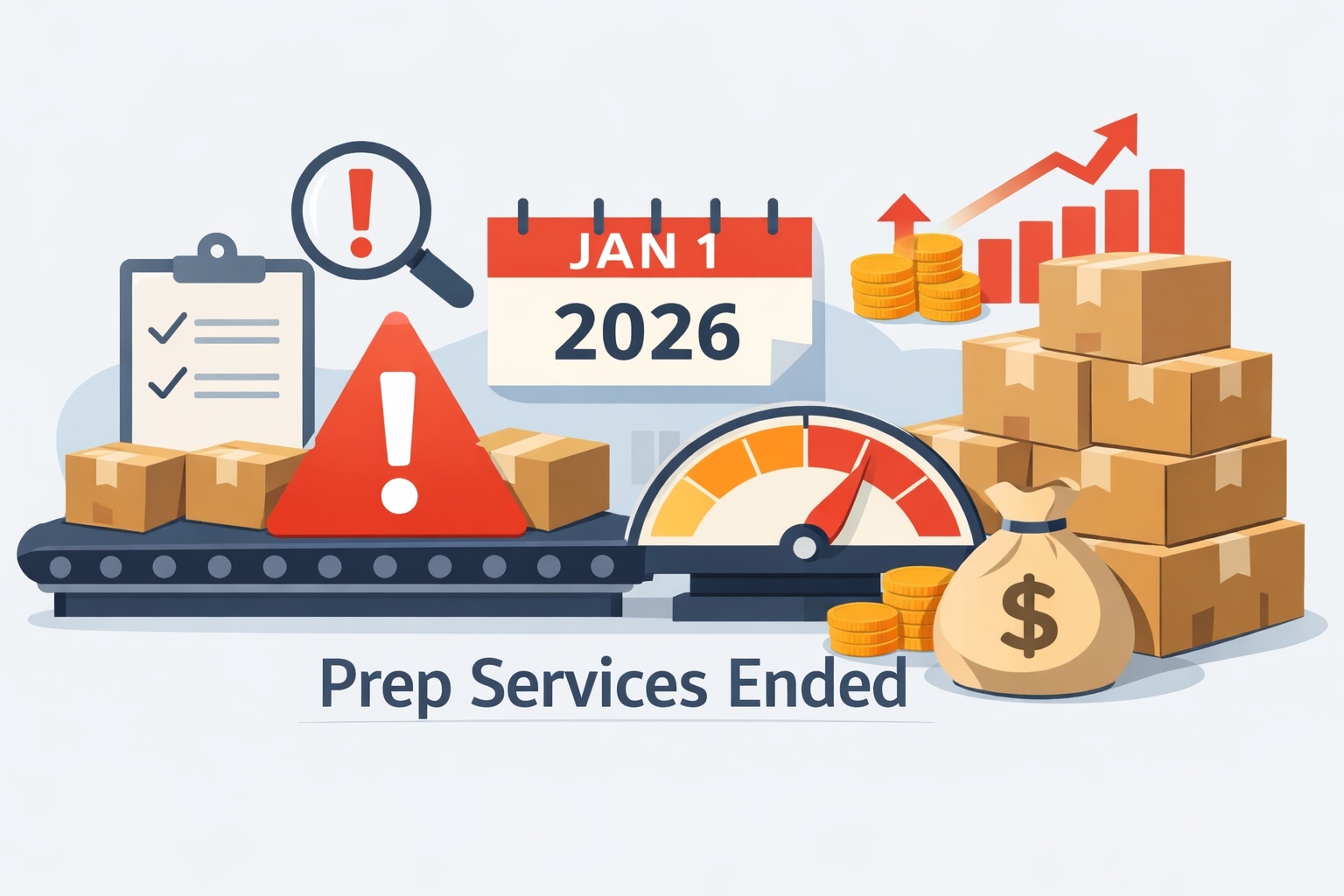
Amazon stopped doing your prep on January 1, 2026. If you're still figuring out what that means for your business — or if you've already had a shipment hit with defect fees — this post is for you.
What Actually Changed on January 1, 2026
For years, Amazon sellers could pay Amazon directly to handle prep tasks at the fulfillment center: applying FNSKU labels, polybagging units, adding bubble wrap, and other inbound requirements. It was convenient, though expensive. That option is now gone.
As of January 1, 2026, Amazon no longer offers prep services at its fulfillment centers. Every unit arriving at an Amazon FC must already meet full inbound compliance requirements before it leaves your hands — or your prep center's. Amazon is not catching it for you anymore.
This is a fundamental shift in how Amazon operates its inbound network. And based on the conversations we're having with sellers right now, a surprising number of businesses that were relying on Amazon-managed prep have not fully adapted their workflows yet.
The New Fee Structure Is Not Forgiving
Here's where sellers are really feeling the pain. Amazon has introduced inbound defect fees that apply whenever a shipment arrives at a fulfillment center out of compliance.Fees for inbound defects for "Small standard" and "Large standard" product size tiers now ranges from $0.32 to $1.74 per unit versus $0.02 to $0.07 before. The fees have become steeper, and more granular. One important distinction is the incorporation of inbound placement service fees in the defect fee structure. This means you are paying for placement fee for units deleted or abandoned from the shipment. Put simply, the accuracy of shipment creation and routing has become much more critical.
What High-Volume Sellers Are Getting Wrong Right Now
The sellers struggling most with this transition fall into a few clear patterns.
Scrambling with an underequipped prep center
A seller recently told us they had been working with a prep center that couldn't keep up with their volume. They weren't getting real-time inventory updates — units would arrive at the prep center and disappear into a black hole for days. When they raised concerns, responses were slow and vague. They only found out something was wrong when their Amazon shipment showed late or incomplete, and after being saddled with much higher inbound defect fees. At that point, the clock is already working against you.
This kind of operational gap is more common than sellers expect. Not all prep centers are built to handle 1,000+ units per month with the visibility and communication that volume requires. Choosing the wrong partner in 2026 doesn't just cost you time — it costs you in defect fees, delayed inventory, and lost sales velocity.
Trying to self-prep at scale
Some sellers moved quickly to bring prep in-house when Amazon made this announcement. For sellers doing fewer than 300–400 units per month, that can work. But for high-volume sellers, the labor cost, physical space, and error rate of self-prep at scale usually outweigh the per-unit savings — especially when a labeling mistake on 500 units now means $160 to $870 in defect fees before you've sold a single item.
Underestimating FNSKU labeling requirements
With commingling ending March 31, sellers who have never needed FNSKU labels before are suddenly responsible for labeling every unit correctly. The label must be scannable, correctly placed, and match the ASIN and condition exactly. Amazon's tolerance for errors here is low.
What You Should Do Right Now
If you haven't already audited your inbound workflow since January 1, that audit is overdue. Specifically, you should confirm that every unit in your pipeline has a compliant FNSKU label applied before it ships to Amazon, that your polybagging and protection requirements are being met at the item level, that your box content information is accurate and submitted correctly, and that whoever is handling your prep — whether in-house or a third party — is giving you real-time visibility into what's been processed and what's pending.
On the prep center side, ask hard questions. Can they show you live inventory counts? Do they communicate proactively when there's a problem, or do you have to chase them? What's their error rate on labeling ans shipment creation? Do they have experience with high-volume Amazon sellers specifically? These questions matter significantly more in 2026 than they did in 2025.
How PrepMeisters Handles This
We built PrepMeisters specifically for Amazon sellers who need prep done right the first time, with full visibility and no guessing. We handle FNSKU labeling starting at $0.80 per unit, along with polybagging, bubble wrap, kitting, and full compliance review before anything ships to Amazon.
Every client gets real-time inventory tracking — you know exactly what's been received, what's been prepped, and what's been shipped at any point in time. And when there's an issue, you hear from us first, not from Amazon's defect report.
We're based in Princeton Junction, NJ, which gives East Coast sellers a fast, cost-effective inbound path to Amazon's northeastern fulfillment network.
The Bottom Line
Amazon's decision to end FBA prep services was not a minor policy update — it was a structural change to how inbound compliance works. The sellers who adapt quickly, with the right prep partner, will avoid the fees and maintain their inventory velocity. The ones who don't will subsidize Amazon's fulfillment efficiency one defect fee at a time.
If you're re-evaluating your prep setup right now, we're happy to talk through your volume, product types, and timeline — no commitment required.
Ready to Fix Your Prep Workflow?
Get a free quote from PrepMeisters. Transparent pricing. Real-time inventory visibility. No black holes.
Get a Free Quote