Amazon's Inbound Placement Service fee is one of the most consistently misunderstood costs in an FBA seller's P&L. Most sellers know it exists. Few have ever pulled their actual data, let alone build a deliberate strategy around it — which means they might be paying a higher rate on every shipment, month after month, by default.
At 3,000 large standard units per month on a minimal split, you're likely paying somewhere between $1,500 and $2,400 in placement fees alone. Annualized, that's $18,000 to $28,800 — on a single line item that most sellers treat as fixed and unavoidable. It isn't. The fee is a direct function of how well your inbound operation aligns with what Amazon's fulfillment network actually needs. And that alignment is something you can control — if you understand why the fee exists in the first place.
Section 1: Why This Fee Exists — The Network Architecture Behind It
To understand why the fee is structured the way it is — and more importantly, how to reduce it — you need to understand what Amazon's fulfillment network actually looks like today and why it was rebuilt.
The old national model
Before 2021, Amazon operated primarily as a single national fulfillment network. A seller could ship to one fulfillment center in New Jersey, and Amazon would move inventory wherever it was needed — including by air — when a customer ordered. Though fulfillment centers in proximity to the destination received priority, there were plenty of shipments flowing cross-country. As volume scaled, the cost of reactive, long-haul fulfillment became unsustainable. The national model had hit its limits.
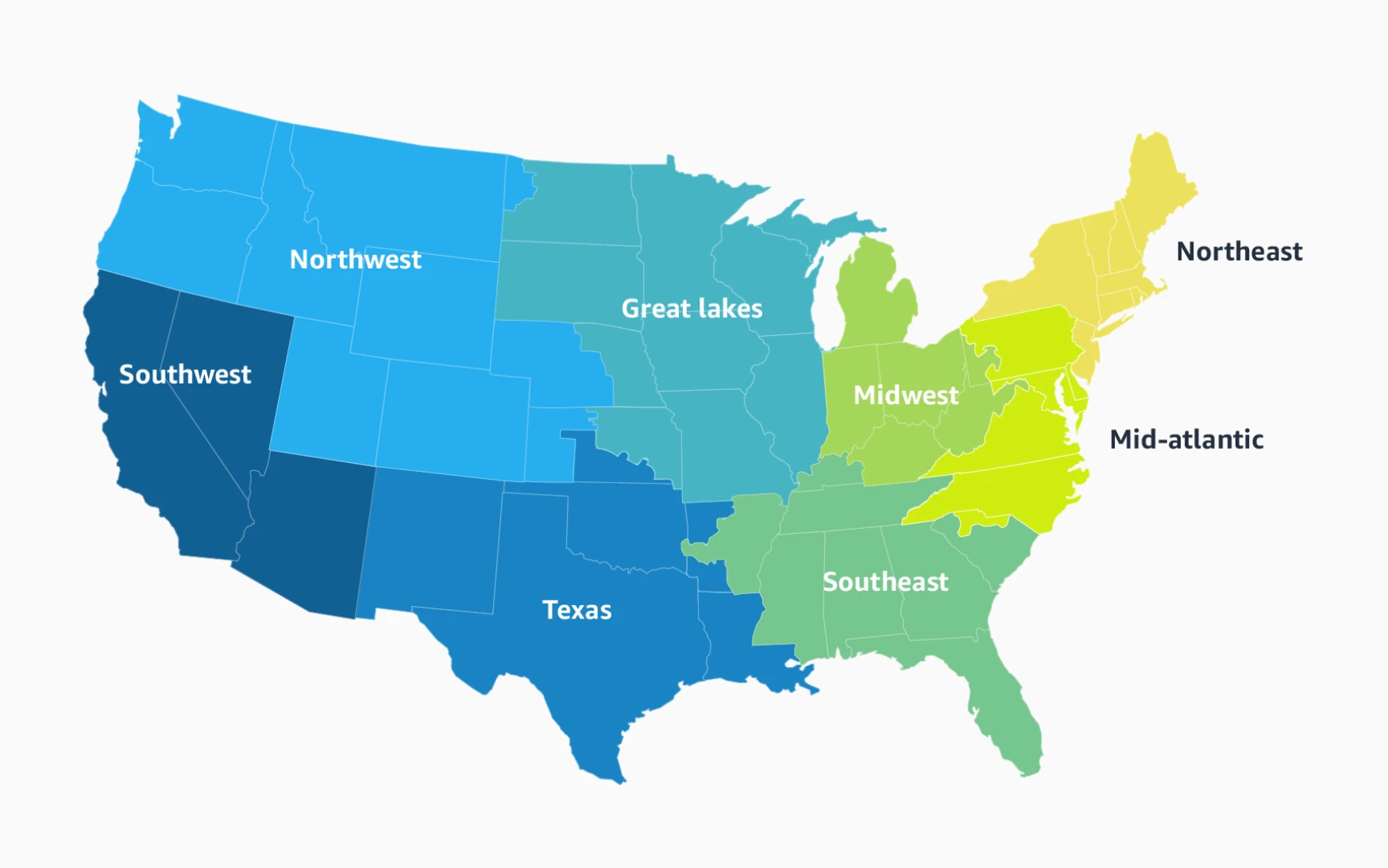
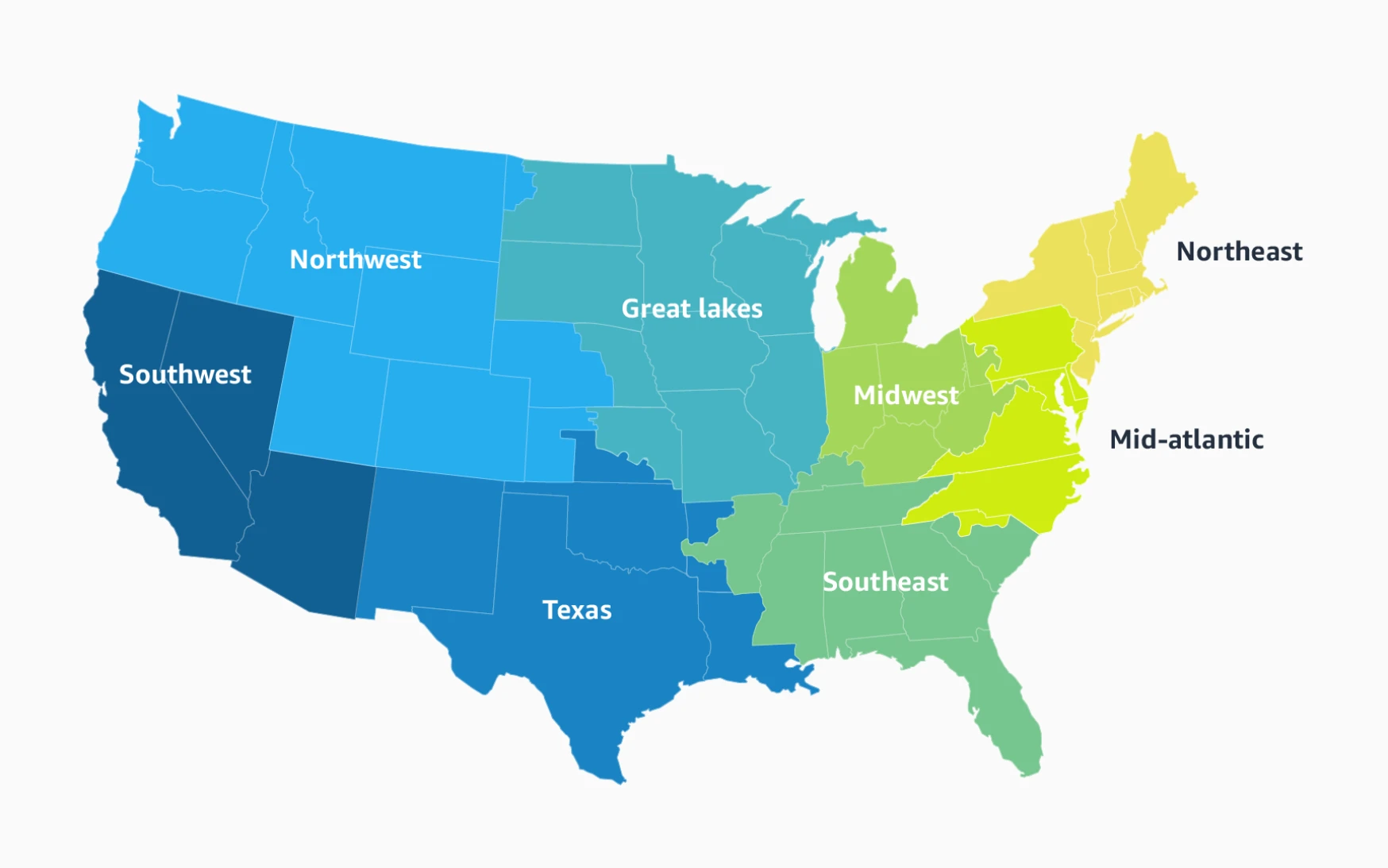
Regionalization: 8 self-sufficient networks
Starting in 2021 and fully deployed by March 2023, Amazon restructured its entire US operation into eight largely self-sufficient geographic regions. The stated goal was to fulfill the vast majority of customer orders from inventory already within the customer's region — eliminating cross-country shipping on the back end by getting inventory pre-positioned on the front end.
The results were significant. According to Amazon,1,2 in-region fulfillment jumped from 62% to 76%. Average delivery distance fell by 15%. Middle-mile touchpoints dropped by 12%. And Amazon's cost-to-serve fell year over year for the first time since 2018, saving over $0.45 per unit in the US alone.
In 2024, Amazon created a two-tier national inbound system built around two types of facilities:
Regional IXDs (rIXDs) — the existing network of Inbound Cross-Dock facilities that have operated for years. These are true cross-docks: inventory comes in one set of bay doors and goes straight back out to nearby FCs on the other side. They average around 600,000 square feet and are explicitly not storage facilities — they are high-throughput sorting buffers that sit between sellers and FCs.
National IXDs (nIXDs) — a new facility type introduced in 2024, averaging about 1 million square feet each. Amazon has added approximately 23 million square feet of nIXD capacity and continues to add more. Inventory enters the national network at an nIXD, is sorted and routed to the appropriate rIXD for the correct region — or in some cases directly to FCs — which then flows inventory to the right FC within that region.
The two-tier system solves the pre-distribution problem by moving inventory across regions cheaply, in bulk, in full truckloads, on the front end — rather than expensively, in small parcels, after a customer has already ordered. The implication for sellers is fundamental: the regionalized network requires your inventory to be pre-distributed across regions before a customer orders — not moved reactively after the fact. That is the entire strategic logic behind the IPS fee. When you ship everything to one location, you are handing Amazon a logistics problem it built an entire national infrastructure to solve. The fee is what they charge you for solving it.
What this means in plain English
When you ship to one location on a minimal split, you are using Amazon's national inbound infrastructure as a distribution service. The nIXD receives your inventory, routes it across rIXDs and/or directly to FCs. Amazon built billions of dollars of infrastructure to do this. The IPS fee is the per-unit charge for that service.
The sellers who pay the least are the ones who solve part of this problem themselves — pre-distributing inventory across regions before it enters Amazon's network, so Amazon's inbound infrastructure has less work to do. Since you are spending more in shipping costs to ship to 5 or more locations directly versus shipping to a single destination, you are bypassing Amazon's inbound network. For the right product mix and volume, there are gains in terms of overall spend and speed to prime eligibility for the units.
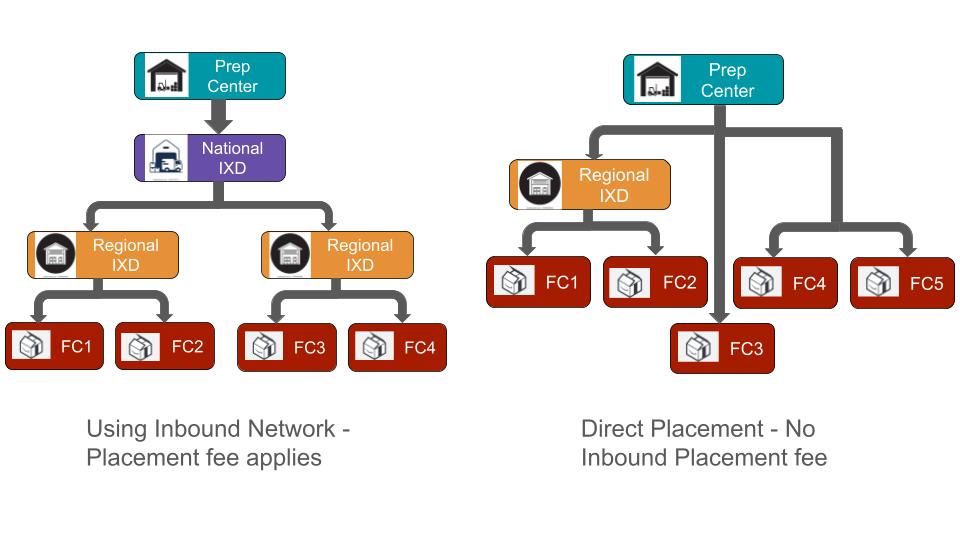
Amazon-optimized split (right) — seller pre-routes to multiple FC destinations, eliminating the placement fee.
Section 2: What the Fee Structure Looks Like in 2026
Inbound options
When you create a shipment plan in Seller Central, you choose from two primary placement options. (A third option — Partial split — applies only to Bulky-sized inventory and is not covered here.) Understanding what each one actually represents in terms of network usage is important.
Minimal split — one or a few inbound locations, highest fee. You ship everything to a single or a few (most often to 1) IXDs. Amazon handles all regional distribution from that point. For small standard-size items, fees run from $0.14 to $0.32 per unit depending on weight and location. For large standard items, fees run from $0.20 to $1.90 per unit. As of January 15, 2026, minimal split fees increased by an average of $0.05 per unit, and large standard items in the 3–20 lb range were restructured into five new weight bands — meaning heavier items in this tier are now disproportionately expensive on a minimal split.
Amazon-optimized split — five or more inbound locations, zero fee. You ship to five or more Amazon-designated FC locations. No placement fee is charged. However, to qualify, your shipment must include at least five identical cartons per item, with the same quantity per item and the same item mix in each carton. This threshold is the critical constraint that makes Amazon-optimized unreachable for most multi-SKU OA and wholesale sellers at typical per-SKU volumes.
The 45-day billing delay — why this fee is systematically undertracked
IPS fees do not appear on your invoice at the time of shipment. They are charged 45 days after the shipment is received at Amazon, appearing as line items in your transaction report under "Inbound Placement Service Fee." This delay means most sellers have never seen their actual cumulative total. The cost is spread across monthly statements in a way that makes it genuinely easy to miss — especially if you are not pulling and filtering transaction reports regularly.
Pulling a 90-day transaction report and filtering specifically for placement service fee entries is the only way to establish your real baseline. Most sellers who do this for the first time find the number materially higher than their estimate.
Section 3: The Math — A Real Example
Wholesale seller, concentrated SKUs, 4,000 units/month
A wholesale seller running 15 active SKUs at roughly 270 units per SKU per month. Products are large standard, averaging 4 lbs. Currently on minimal split.
Current cost:
Placement fee: ~$0.61/unit × 4,000 units = $2,440/month ($29,280/year)
What's actually available to them: At 270 units per SKU, this seller is shipping 10–15 cartons per SKU per shipment — well above the 5-carton threshold. They qualify for Amazon-optimized splits on every major SKU. The placement fee could be eliminated entirely.
Why they haven't done it: Their current prep operation ships in single-destination batches. Executing Amazon-optimized requires routing outbound freight to 5 separate destinations per shipment, which their current setup doesn't support — or they simply haven't tackled the additional complexity.
Net savings after increased multi-destination freight costs: At this volume, shipping to 5 locations increases freight spend by approximately $6,000–$8,000 per year depending on origin geography and carrier rates. Against $29,280 in current placement fees, the net saving is approximately $21,000–$23,000 per year — before accounting for the speed-to-Prime-eligible-listing gains that come from getting inventory to FCs faster than routing through Amazon's inbound network.
The key insight: The right inbound strategy is not the same for every seller, and it is not determined by volume alone. It is determined by SKU concentration, units per SKU per shipment, product size and weight tier, and where your inventory is being prepped and shipped from relative to Amazon's regional FC clusters. For some sellers, switching strategies can drastically reduce inbound costs — but only if their prep and logistics operation is capable of executing multi-destination splits.
Section 4: Why Geography Is a Lever Most Sellers Ignore
The economics of an optimized split are not the same for every seller in every location. Where your inventory originates — specifically, where it is prepped and handed off to a carrier — has a direct and material effect on whether splitting shipments across regions saves money or costs more than the placement fee itself.
How Amazon's regional FC density creates geographic advantages
Amazon's eight regions are not geographically symmetric in terms of FC density or inbound infrastructure. The Northeast corridor — encompassing the Mid-Atlantic and New England regions — contains one of the highest concentrations of FCs, nIXDs, and rIXDs in the entire country. This is a direct result of population density: approximately 40% of the US population lives within a day's drive of the NY/NJ metro area, and Amazon's network reflects that customer concentration with proportionally dense infrastructure.
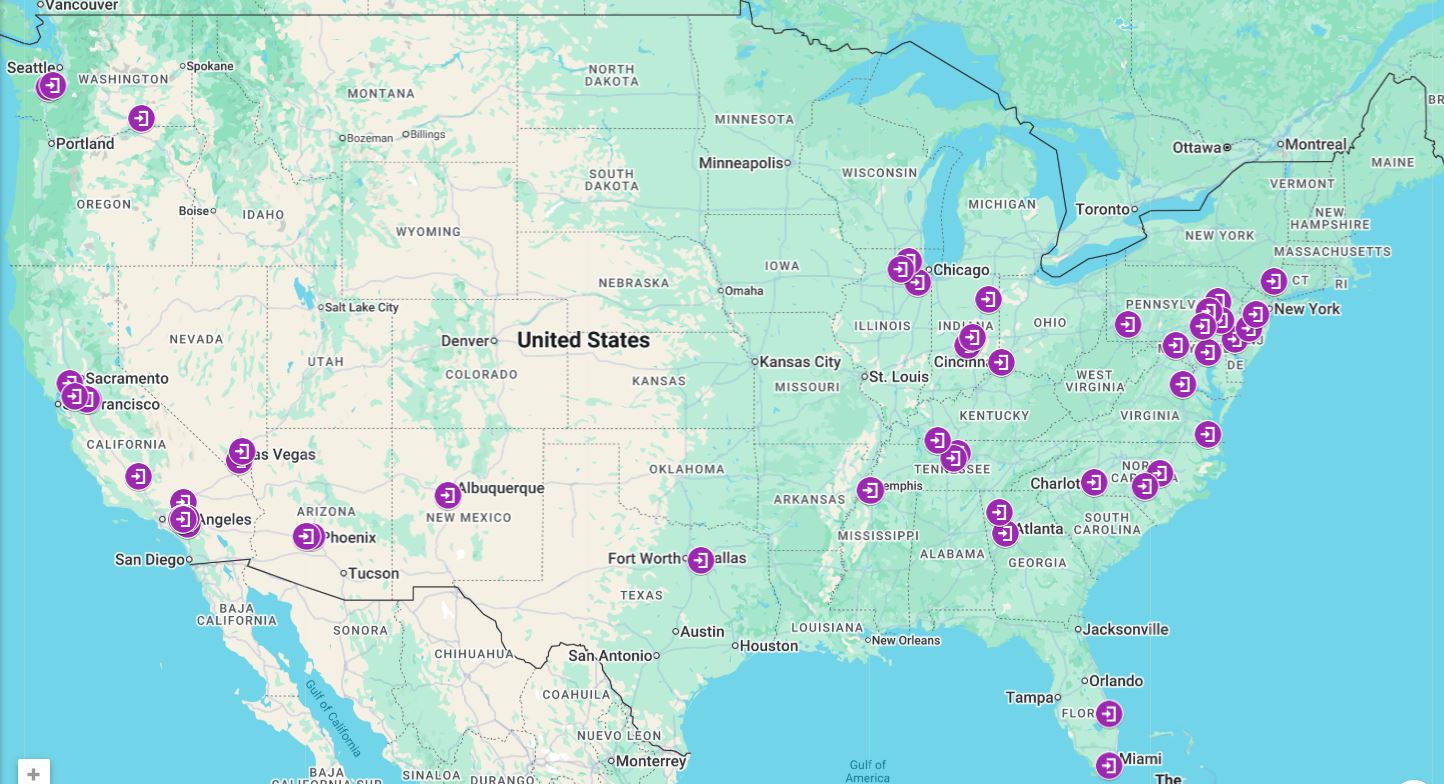
For sellers, this creates a freight cost dynamic that is easy to overlook. A split originating from Central New Jersey can realistically reach FC clusters serving three distinct Amazon regions — the Northeast, Mid-Atlantic, and a third region such as the Southeast — with distances that are structurally shorter and cheaper than the same split originating from, say, Nashville or Dallas. The same split that is cost-effective from a NJ prep center may be freight-prohibitive from a prep center in a less FC-dense geography.
Section 5: Three Levers That Actually Move This Fee
Lever 1: Shipment batching — stop shipping too small and too often
The most universal and underused optimization available to multi-SKU sellers. Most OA and wholesale sellers ship as inventory arrives — per-order, or as individual supplier deliveries come in. At 10–20 units per SKU per shipment, you will never meet the 5-carton threshold for Amazon-optimized, and you guarantee yourself the highest per-unit placement fee on every single shipment.
Holding inventory at a prep center for weekly or bi-weekly batch release — consolidating to 5+ cartons of the same SKU before creating a shipment plan — is the single most accessible path to qualifying for lower placement tiers. It requires no operational change on the sourcing side. It requires only that your prep center has short-term storage capability and runs batched outbound shipments rather than shipping each delivery the day it arrives.
A home prep operation can theoretically do this, but in practice rarely does. The discipline of holding and batching across multiple supplier deliveries, while tracking what's on hand per SKU, is operationally demanding enough that most sellers default to shipping as inventory accumulates. A prep center with systematic batch management removes this friction entirely.
Lever 2: Make a systematic, data-based decision
Counterintuitive but important: for some SKU profiles and shipment sizes, a minimal split is still the lowest total landed cost option even after accounting for the placement fee.
The decision framework is straightforward: if the incremental freight cost of splitting to additional regional locations exceeds the placement fee savings on that shipment, take the minimal split.
The mistake most sellers make is applying a blanket policy — always minimal, or always trying to avoid the fee — rather than running the calculation per SKU and per shipment size. At high volume across a mixed catalog, the right answer is almost always different for different parts of your inventory.
Lever 3: Evaluate AWD — it works for some sellers and not others
Amazon Warehousing and Distribution (AWD) eliminates the IPS fee entirely. Amazon handles placement automatically from its AWD facilities. For the right seller profile, this is genuinely compelling.
AWD works best when: you have high-velocity SKUs with consistent, predictable demand; you are comfortable relinquishing direct Seller Central control over inbound timing; and your SKU count is low enough that AWD's inventory management tools are practical to use.
AWD is a poor fit when: you are running 30+ SKUs at variable and unpredictable velocities (typical OA/wholesale profile); you need precise control over which inventory hits FBA and when for cash flow reasons; or your SKUs have expiration dates, prep complexity, or compliance requirements that AWD's standardized handling doesn't accommodate well.
For most multi-SKU OA and wholesale sellers, AWD introduces more operational constraints than it removes in fee savings. Evaluate it carefully against your specific SKU profile before committing. Partnering with a prep center that can accommodate volume fluctuations with low storage fees is often a more flexible and cost-effective alternative.
Section 6: What to Do This Week — A 5-Step Audit
If you've never deliberately analyzed your inbound placement costs, these five steps will give you the complete picture in a few hours.
Step 1: Pull your 90-day transaction report. Pull your transaction report from Seller Central for past 90 days. Filter for "Inbound Placement Service Fee" entries. This total is your baseline — and for most sellers doing this for the first time, the number is higher than expected.
Step 2: Segment by product size tier. Large standard items over 3 lbs are your highest-fee items following the January 2026 weight band restructuring. Identify which SKUs in your catalog fall into this category and what percentage of your total placement fees they represent.
Step 3: Calculate your units per SKU per shipment. For your top 10 SKUs by volume, calculate how many units and cartons you are typically shipping per SKU per shipment plan. If you are consistently below 5 cartons per SKU, you are structurally disqualified from Amazon-optimized regardless of total monthly volume.
Step 4: Run the freight versus fee comparison on your top SKUs. For your highest-fee SKUs, get a freight quote for a typical 5 region split from your current prep/ship origin point. Compare the incremental freight cost against the placement fee savings. This single calculation tells you whether a partial split is actually worth doing for that SKU — and the answer is usually different for different parts of your catalog.
Step 5: Assess your inbound geography. Where is your inventory currently being prepped and shipped from? How far is that origin from the nearest 2–3 Amazon regional FC clusters? If you don't know the answer, you don't have an inbound strategy — you have a default. The geographic starting point of your inbound freight is one of the most controllable variables in your total placement cost, and it's the one most sellers never examine.
A Note on This Analysis for New PrepMeisters Clients
Most sellers have never run the full inbound cost analysis described above — the data exists in Seller Central, but pulling it, analyzing it, and modeling the optimized split alternative against real freight costs takes time and requires knowing what you're looking for.
For new clients, we will do this analysis for you at no charge. This offer is available to new clients committing to a minimum of 1,000 units per month for at least 6 months. You will pull your last 90 days of transaction data from Seller Central and share it with us, and we will return a clear breakdown: what you have paid in IPS fees, which SKUs are driving the most cost, whether your current split strategy is optimal for your catalog, and what an optimized split from our Central NJ facility would actually cost in freight terms for your specific product profile.
To get started, request a quote and mention the inbound cost analysis in your submission.
References
- Sizing down to scale up: How Amazon reworked its fulfillment network to meet customer demand, by Sarah O'Neil, published on amazon.science, July 24, 2023.
- Regionalize and Scale: Amazon's Fulfillment Network Design for Faster and Cheaper Delivery, by Sinha et al., published in INFORMS Journal on Applied Analytics, Vol. 56, No. 1, January 30, 2026. https://pubsonline.informs.org/doi/10.1287/inte.2025.0295
- An UPDATED Brief Primer on Amazon's Distribution Network, by Benjamin Y. Fong, May 19, 2025. https://ontheseams.substack.com/p/an-updated-brief-primer-on-amazons
Ready to Get Started?
Let PrepMeisters handle your Amazon FBA prep with the expertise that comes from a decade inside Amazon. 100% compliant prep, every time.
Get a Free Quote