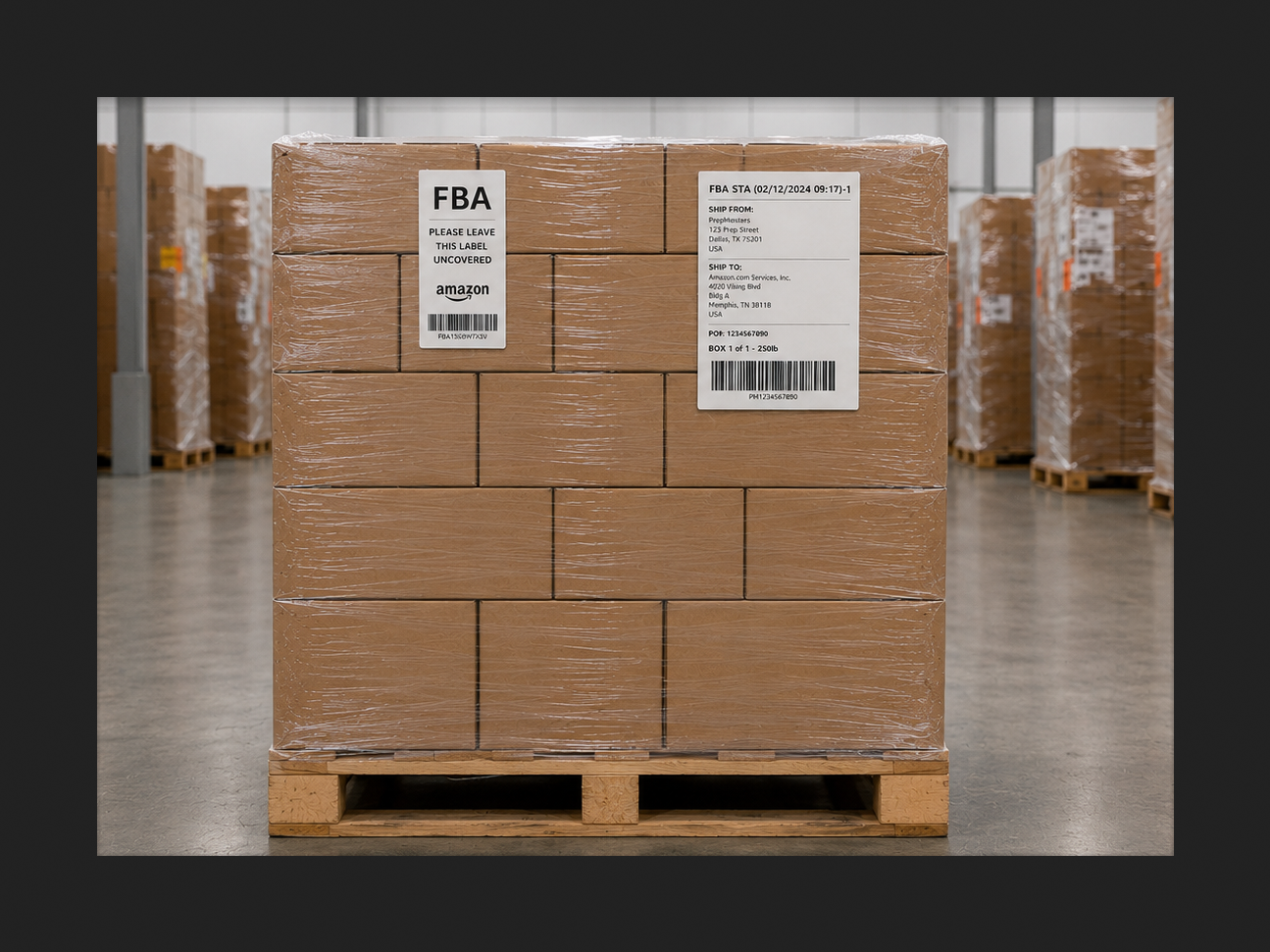
If you're moving more than 5,000 units a month, you're not sending in the occasional small-parcel box — you're running LTL and FTL freight, often multiple pallets per truck, every week. At that volume, a single non-compliant pallet isn't a minor inconvenience. It can hold up an entire truckload at the dock, delay every ASIN riding on that freight, and put a dent in the sales velocity you've worked so hard to build.
In my years running Amazon fulfillment operations, pallet-level issues — unsafe loading, stacking, wrapping, label placement, weight distribution — were a recurring and entirely preventable source of inbound rejections, separate from any product compliance problem. They also compound with scale: the more pallets you ship, the more chances there are for one of them to get flagged, and the more inventory sits in limbo while it gets fixed.
The good news is that these issues are preventable. By following these guidelines, not only would your freight be compliant with Amazon standards but you will also witness a smooth and quick receipt of your inventory.
Rule 1: Select Correct Pallet Type and Grade
Amazon requires 40 x 48 inch, 4-way access wooden pallets. Plastic, cardboard, or particle-board pallets are not acceptable.
- General freight: GMA Standard B Grade or higher (6–7 top boards depending on width, no fewer than 4 bottom boards, stringers, 4-way entry, no block repairs to stringers).
- Grocery products: GMA 1A Grade only (7 top boards, 5 bottom boards, stringers, 4-way entry, no block repairs).
- Health & personal care / beauty products: GMA 1A or 1B Grade only.
- Condition: broken or damaged pallets are not acceptable and may be rejected at the seller's expense. Further, if pallet has nails or splinters exposed which make it unsafe to handle, the pallet can be sidelined for safety reasons.
If a single oversized unit won't fit a standard 40 x 48 pallet without overhanging, use a pallet sized appropriately for that unit instead. At volume, it's worth standardizing pallet grade and supplier across your whole operation — mixing grades across a multi-pallet FTL shipment is how one bad pallet ends up holding up the rest of the truck.
Rule 2: Build Pallet Securely
- Stack boxes stable and flush on all sides — brick-stack with the heaviest boxes on the bottom.
- Build with FBA box ID labels facing outward so barcodes can be scanned without breaking down the pallet.
- On single-ASIN pallets, every box must be stacked the same orientation (all horizontal or all vertical).
- Physically separate ASINs on a pallet so they're easy to tell apart at receiving.
- Contents must never overhang the pallet edge, and boxes can't be bundled with bags, elastic, or extra straps in place of proper stacking.
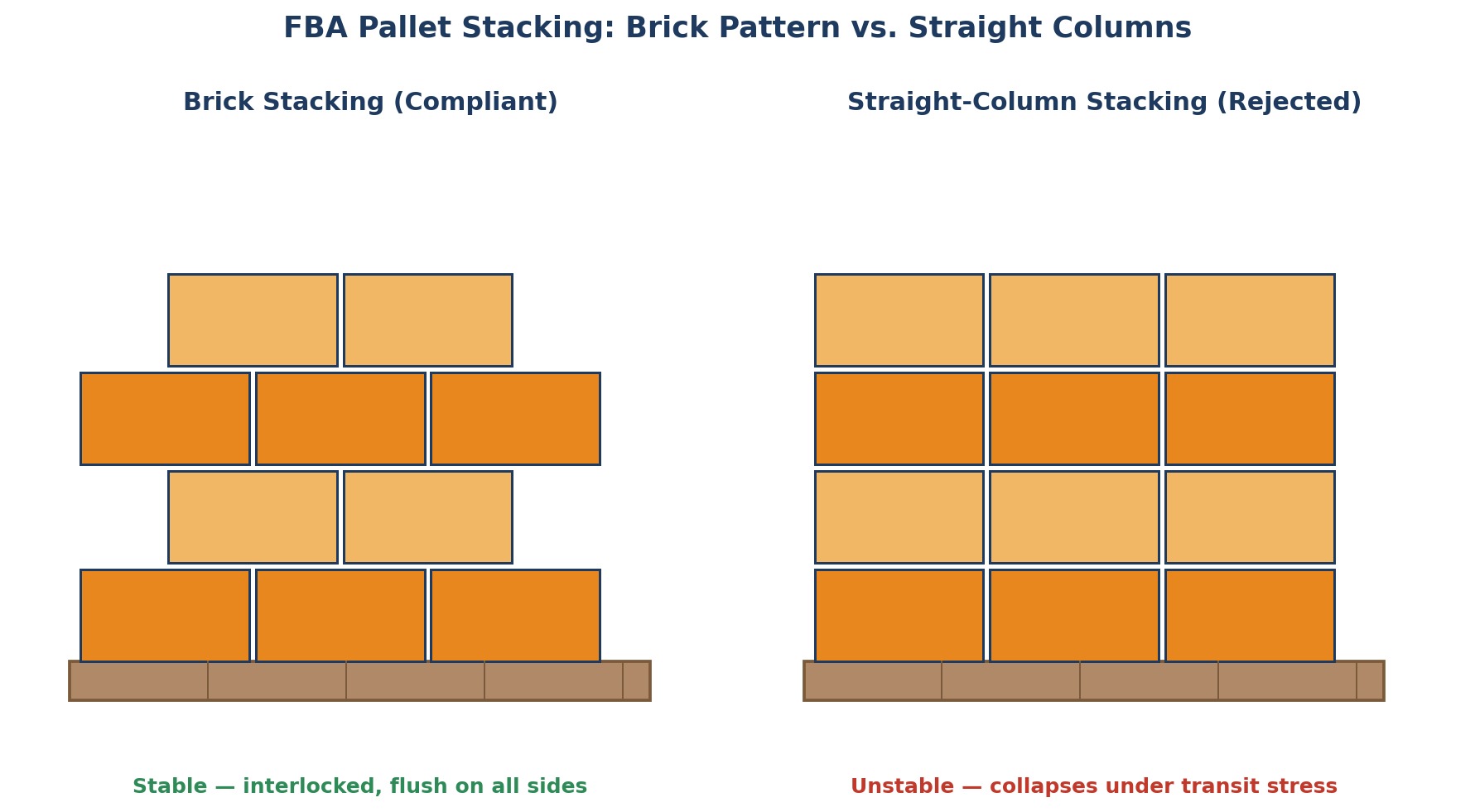
Stackable pallets ideally keep a pack height of 50 inches or less (45 inches of boxes, 5 inches of pallet) — that's what makes a pallet space-efficient in a trailer, which matters directly to your freight cost per unit at scale.
Pro-tip: If you can generate single-SKU pallets, do it. This is one of the highest-leverage moves available to a high-volume shipper. A single-ASIN pallet can be routed through Amazon's pallet receive process — the FC scans the pallet label, validates it, and moves the whole thing into inventory at once. A mixed-SKU pallet doesn't get that shortcut: it has to be broken down and run through case receive or each receive, which are inherently slower, more labor-intensive processes on Amazon's side. At low volume, building single-SKU pallets often isn't practical — you don't have enough of any one ASIN to fill a pallet. But once you're moving 5,000+ units a month, consolidating by ASIN before it hits the truck is usually worth the extra planning, because it's the difference between your inventory clearing receiving in hours versus days.
Rule 3: Adhere to Weight and Height Limits
- Total pallet weight: 1,500 lb maximum.
- Standard height: 72 inches, including the pallet itself, unless a single unit is taller than that.
- Clampable freight: can go up to 98 inches — but a 98-inch pallet gets "squeezed" and split into two by Amazon's clamp truck on receipt. Cartons under 16 lb each that are clampable can be single-stacked up to 104 inches without a slip sheet or separator; cartons over 16 lb each are capped at 72 inches.
- Partnered carrier shipments: single pallets must be no higher than 72 inches on a 40 x 48 pallet. For freight efficiency, aim for stackable pallets no higher than 100 inches total (50 inches each).
- Double-stacked pallets: combined height can't exceed 100 inches (50 inches per pallet stack), with at least 6 inches of clearance to the container ceiling for safe forklift unloading.
- Per-box weight: standard limit is 50 lb unless the box contains a single oversize unit. Boxes over 50 lb need a "Team Lift" label; over 100 lb need "Mech Lift."
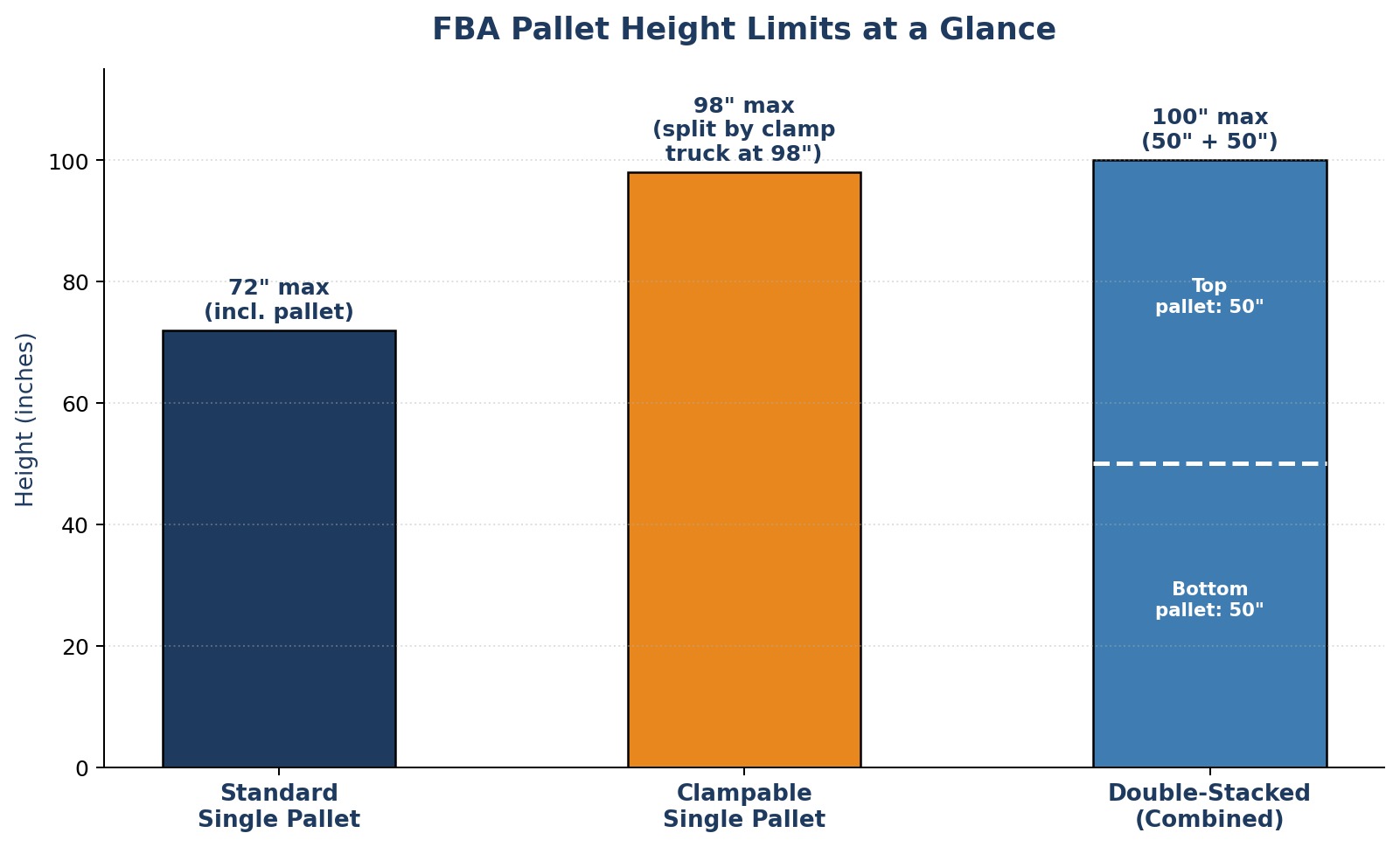
Double-stacking and clampable freight are where high-volume shippers actually capture freight efficiency — but they're also where the rules get more nuanced, and where a misjudged stack height costs you the most relative to a single small-parcel box.
Rule 4: Secure with Stretch Wrap
All pallets must be wrapped in clear plastic stretch wrap with a "Do not break stretch wrap" or "Do not break down" note for the carrier. The wrap needs to fully secure the load to the pallet to prevent shifting in transit — but Amazon is explicit that the wrap itself can't be what's stabilizing the load. The stack has to be stable on its own; if you cut the wrap off and it collapses, it wasn't built correctly to begin with.
Amazon doesn't specify an exact number of wrap layers, but it's worth standardizing one across your operation rather than leaving it to feel. Best practice to follow here is the 3-2-1 rule: 3 layers of wrap around the top of the load, 2 layers around the middle body, and 1 layer at the bottom that catches the top edge of the pallet itself to anchor the load to its base. It's a simple enough rule to train into any team, and it consistently produces a wrap job that holds up over the length of a haul without over-wrapping and adding unnecessary material cost. At scale, this is the kind of detail worth building into a standard operating procedure for whoever is palletizing your freight, rather than relying on each shift to get it right by feel.
Rule 5: Place Labels Correctly
This is where a lot of otherwise-compliant pallets get rejected. Amazon's actual requirement:
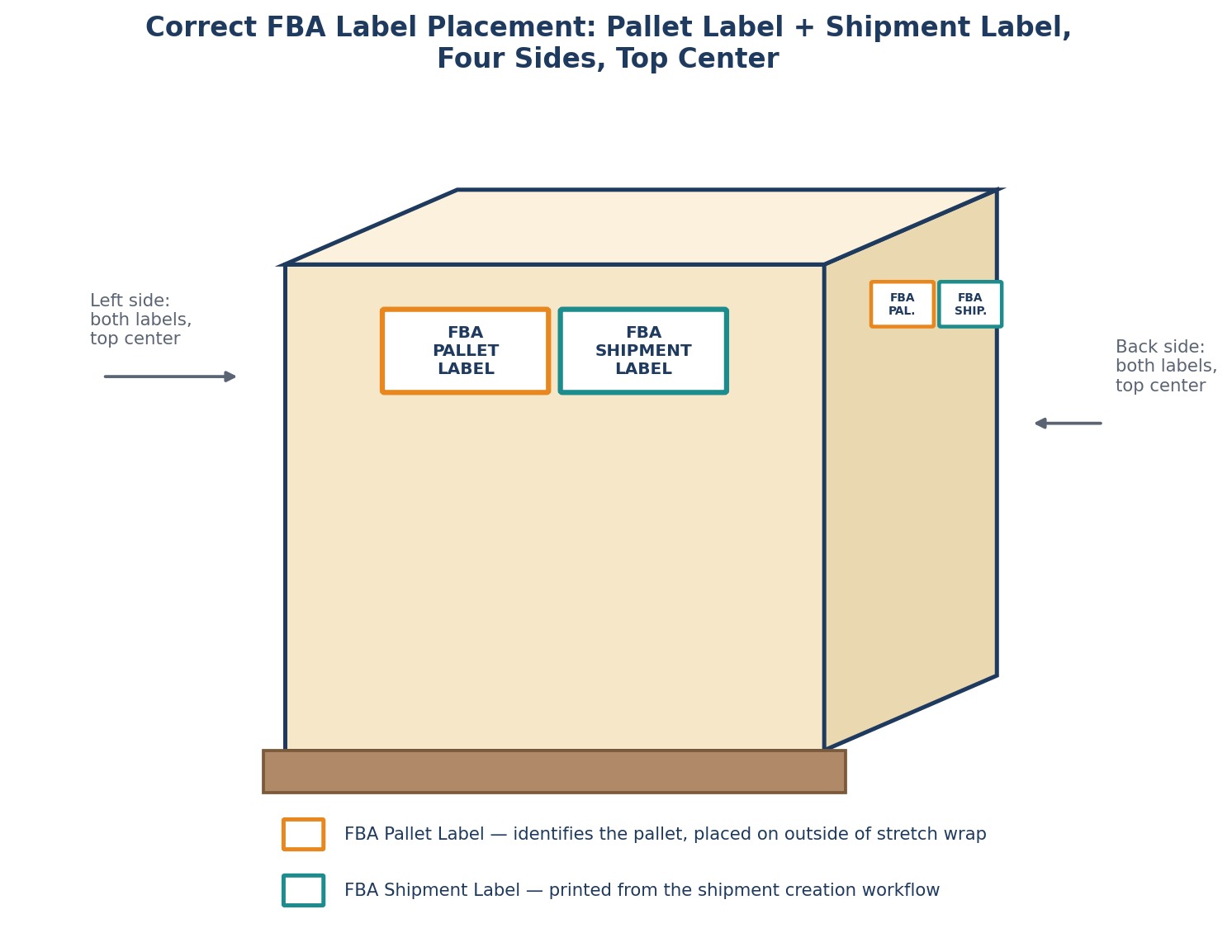
- FBA pallet labels and FBA shipment labels go on all four sides of the pallet, on the outside of the stretch wrap — four labels per pallet, one per side, placed in the top center.
- Labels must sit squarely, not angled, so a forklift driver can read them on approach from any direction.
- Single-ASIN pallets get a "Single ASIN pallet" label; mixed pallets need a "Mixed SKU" label plus clear physical separation between SKUs.
What's New: RFID Seals for FTL and Intermodal
From September 12, 2024, full truckload and intermodal shipments must be sealed at pickup with an ISO-17712-compliant, Amazon-approved RFID seal — not just any metal or plastic seal. The seal number has to be recorded on the bill of lading next to the carrier's SCAC and PRO number. Drivers are authorized to refuse pickup if the trailer isn't sealed or the BOL is missing the seal number.
This one is specific to FTL — if you're shipping LTL or small parcel, your carrier handles sealing at the consolidation terminal and you don't need to think about it. But if you're at the volume where you're booking full truckloads directly, this is now a hard gate on your shipment leaving the dock, and it's worth confirming your carrier has it built into their pickup process.
The Bottom Line
A rejected shipment doesn't just cost you the fees to re-handle and reschedule it — it costs you the days of lost sales velocity while your inventory sits in limbo waiting to be re-processed, and at high volume, one bad pallet can tie up an entire truckload of otherwise-compliant freight. Most of these rejections trace back to one of the five rules above, and none of them require anything exotic — just a consistent, final sign-off step before the truck leaves your factory or prep center that checks pallet type, stack height, wrap integrity, and label placement against Amazon's actual published rules.
If you're shipping 5,000+ units a month and want every pallet built to spec the first time — no re-handling fees, no sidelined freight — that's exactly what we do at PrepMeisters.
Ready to Get Started?
Let PrepMeisters handle your Amazon FBA prep with the expertise that comes from a decade inside Amazon. 100% compliant prep, every time.
Get a Free Quote