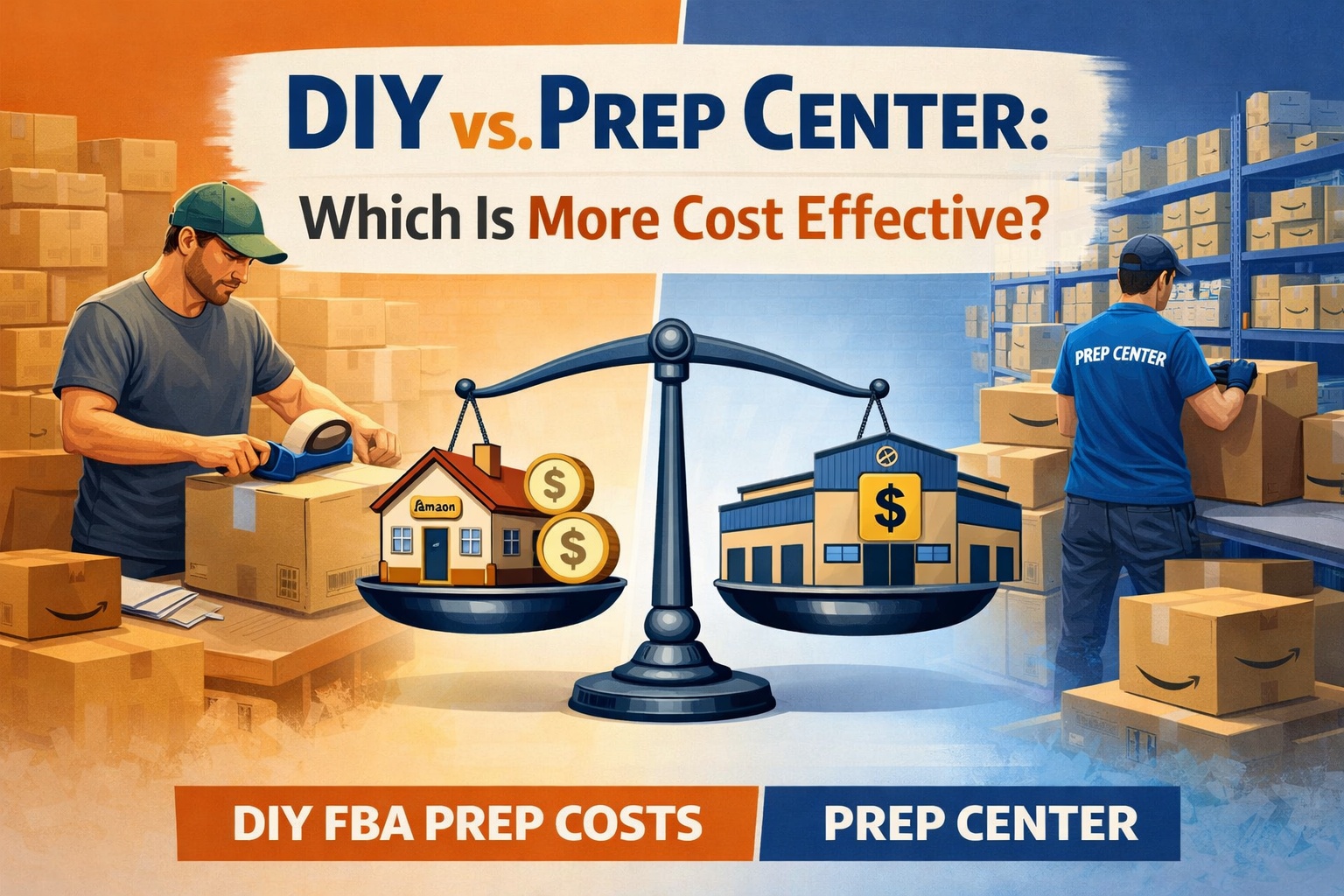
A seller doing 1,000 units a month runs the numbers on a prep center. At $1.12 per unit, that's $1,120 a month. They close the tab, thinking it's too expensive! What they never calculated is that their DIY operation was already costing them $1,250 to $2,060 a month — scattered invisibly across their bank statements, their calendar, their garage, and their inbound defect report. The cost was always there. They just hadn't reconciled it.
That's what this post does. We're going to build the complete picture of what DIY prep actually costs — every visible and invisible line item — and then show you exactly at what volume a prep center stops being a cost and starts being a competitive advantage.
The Costs You See (But Still Underestimate)
Supplies
These are the costs most sellers acknowledge but routinely low-ball because they buy in small quantities and never aggregate the monthly total.
| Supply Item | Cost per Unit (Low) | Cost per Unit (Realistic) | Cost per Unit (High) |
|---|---|---|---|
| Poly bags | $0.06 | $0.10 | $0.14 |
| FNSKU label stock (thermal roll) | $0.01 | $0.02 | $0.03 |
| Tape, dunnage, stretch wrap | $0.02 | $0.03 | $0.04 |
| Thermal printer (amortized over 24 mo.) | $0.01 | $0.01 | $0.02 |
| Shipping box (20-50 units/carton) | $0.11 | $0.16 | $0.28 |
| Total supplies per unit | $0.21 | $0.32 | $0.51 |
Labor — The Hidden Cost
Even at 2 - 3 minutes per unit for receive, inspect, label, and poly bag, labor costs add up. On top of that, there are labor costs to create the shipment plan in seller central and then taking the packages to the carrier. Even at 4 shipments/month, this will equate to additional 3 - 4 hours a month. Here is what the labor costs actually looks like — valued at $20/hour for hired help, or $25/hour for your own time (which is the more important number if you have better uses for your hours).
| Activity | Hours/Month | @ $20/hr (Low) | @ $25/hr (Realistic) | @ $25/hr (High) |
|---|---|---|---|---|
| Prepping units | 33 - 50 hrs | $0.67 | $0.83 | $1.25 |
| Shipping units | 3 - 4 hrs | $0.04 | $0.05 | $0.08 |
| Total labor per unit | 36 - 54 hrs | $0.71 | $0.88 | $1.33 |
Even at 1,000 units/month, you are spending more than 44 hours every month just prepping your units. That is time not spent on growing your business - sourcing, repricing, advertising, or launching new ASINs. For most growing sellers, that opportunity cost is the single largest hidden expense in their business.
Space
If you are prepping at home, you likely aren't paying rent on your prep corner — but it is real space with a real cost. A dedicated 100 to 150 square foot prep area has a commercial equivalent value of $150 to $300 per month in a market like central New Jersey. Even if you value it at zero, it represents floor space your business is consuming that cannot be used for anything else. So, this adds anywhere from a low end of $0 to a high end of $0.30 to the unit costs, with realistic space cost of $0.15/unit.
The Invisible Costs — Where DIY Actually Bleeds
2026 Inbound Defect Fees: The Rules Just Changed Dramatically
This is the section that will change how many sellers think about prep compliance. As described in detail in Amazon FBA Prep Is Gone in 2026, Amazon has Amazon has discontinued all FBA prep and labeling services in the US effective Jan 1, 2026. Every unit now has to arrive fully prepped and compliant. There is no catch-up mechanism. The margin for error just got much smaller. Simultaneously, fee for non-compliant prep items has increased sharply. Inbound defect fees for "Small standard" and "Large standard" product size tiers now ranges from $0.32 to $1.74 per unit versus $0.02 to $0.07 before. One important distinction is the incorporation of inbound placement service fees in the defect fee structure. This means you are paying for placement fee for units deleted or abandoned from the shipment. Put simply, the accuracy of shipment creation and routing has become much more critical.
Here is what that looks like at realistic DIY error rates of 2% to 5% — a range that reflects typical home prep operations, again using our 1000 units/month assumption.
| Error Rate | @ $0.32/unit (Low) | @ $0.60/unit (Realistic) | @ $1.74/unit (High) |
|---|---|---|---|
| 2% | $0.01 | $0.01 | $0.03 |
| 3.5% | $0.01 | $0.02 | $0.06 |
| 5% | $0.02 | $0.03 | $0.09 |
These are floor numbers — they cover the direct fee only. They do not include the cost of sidelined inventory (units that are unavailable for sale while the defect is resolved), lost BSR rank from the sales interruption, or the compounding effect of repeated violations on your account health score. As we covered in our post on why Amazon rejects FBA shipments, a sidelined shipment during peak season can cost multiples more than the defect fee itself.
Lost Selling Velocity
This one is the hardest to put a number on, but it is often the largest real cost. A product selling 10 units per day at a $25 average price, sidelined for just five days while a prep issue is resolved, represents $1,250 in lost revenue. During Q4, with BSR decay and competitor momentum, the true cost is higher still. Unlike a defect fee that shows up on your invoice, this cost is invisible — which is exactly why most sellers never include it in their DIY math.
The Professional Edge: Economies of Scale You Can’t Replicate
Up to this point, we’ve compared your time against our time. But a professional prep center doesn't just do what you do faster; it uses industrial technology that is financially impossible for an individual seller to justify. This technology doesn't just lower costs—it eliminates the "human error" that leads to Amazon rejections.
Take the Heat Tunnel, for example.
Manual shrink wrapping with a consumer heat gun runs at about 20 to 25 units per hour in the hands of a good operator. The seal quality is inconsistent, operator fatigue sets in after 30 to 40 units, and the error rate on packaging quality climbs as the session goes on.
A commercial conveyor heat tunnel changes the equation entirely. Entry-level machines start around $4,000 to $6,000, and paired with an L-bar sealer at another $2,000 to $3,000, a complete setup runs $6,000 to $9,000 before installation. Output: 400 to 600 units per hour with consistent, professional-grade seals every time.
For a solo seller doing 1,000 units a month of shrink-wrapped product, that capital investment would take years to pay off — and that's before accounting for the floor space it occupies. It simply doesn't make financial sense at individual seller volumes.
A prep center handling 15,000 to 20,000 units per month across a shared client base amortizes that investment in 3 to 6 months. The labor cost per shrink-wrapped unit drops from $0.50 to $0.75 (manual) to $0.08 to $0.15 (automated) — and that saving flows into the per-unit rate every client pays. You get heat-tunnel quality at manual-operation pricing, without a dollar of capital outlay.
The same principle applies to high-speed poly bag sealers, automated label applicators that eliminate placement errors, and bulk purchasing of consumables at volumes that dwarf what any individual seller can access. A prep center buying poly bags for 50 client accounts gets pricing that is 40 to 60% below what you can achieve buying a case at a time. Those savings pass through to your per-unit rate.
The Full Cost Comparison — Where the Lines Actually Cross
Let's put every cost on one table for a seller doing 1,000 units per month of online arbitrage:
| Cost Component | DIY — Optimistic (2% errors, free space, helper labor) |
DIY — Realistic (3.5% errors, space counted, owner's time) |
DIY — Challenging (5% errors, full costs, owner's time) |
PrepMeisters (Tier 4 OA rate all inc.) |
|---|---|---|---|---|
| Supplies | $0.11 | $0.16 | $0.28 | $1.12 All-inclusive. No surprises. |
| Labor | $0.71 | $0.88 | $1.33 | |
| Defect fees | $0.01 | $0.02 | $0.09 | |
| Space (notional) | $0.00 | $0.15 | $0.30 | |
| Total / unit | $0.86 | $1.25 | $2.06 | |
| Monthly total @ 1,000 units | $860 | $1,250 | $2,050 | $1,120 |
* DIY optimistic scenario excludes space cost and values labor at $20/hr with 2% error rate at $0.32/unit defect fee. DIY realistic and challenging scenarios value labor at $25/hr. Prep center rate is PrepMeisters published Tier 4 OA rate plus cost of shipment creation, polybags and boxes. Lost velocity costs not included in any column — these favor the prep center scenario significantly.
The optimistic DIY scenario wins on pure unit economics — but only if you value your time at hired-help rates, ignore space cost entirely, and run near-perfect prep. The moment any of those assumptions shifts toward reality, the prep center is already competitive at 1,000 units per month. As can be seen for the realistic scenario, at 1,000/units per month, PrepMeisters is already saving you real money, while freeing your time to grow your business.
The Volume Thresholds — A Practical Decision Framework
So, let's take a look at how the scenarios play out at different volume thresholds and when it makes sense to outsource your prep needs to a professional prep center.
| Monthly Volume | Verdict | What Drives the Decision |
|---|---|---|
| Under 300 units | DIY likely wins on unit economics | Absolute defect fee cost is low; labor hours are manageable. However, if you use a prep center with no minimums, you still gain compliance expertise and free up sourcing time at any volume. |
| 300–500 units | Tipping point | Labor hours start representing meaningful opportunity cost. At 3.5%+ error rate, cost parity with a prep center is reached. |
| 500–1,000 units | Prep center wins | Labor alone approaches or exceeds prep center cost when valued honestly. Automation economies start kicking in. |
| 1,000+ units | Prep center wins clearly | Every dollar of owner time has higher-value uses. The prep center rate drops with volume tiers. The cost gap in every realistic scenario is significant and widens as volume grows and significant economies of scale benefits materialize. |
| Any volume during Q4 | Prep center wins unconditionally | One sidelined shipment in November can cost more than six months of prep fees. DIY throughput bottlenecks during peak season are a well-documented growth killer. |
Ready to calculate your specific costs?
Use our Calculator function to quickly get an estimate on your costs based on your product profile.
Calculate My CostsA Note on Sellers Under 300 Units
Even at lower volumes where DIY wins on pure unit economics, there are real advantages to using a prep center that the cost table doesn't capture. A prep center with no volume minimums means you can send 30 units or 300 units and receive the same expert handling either way — which matters when you're testing new categories, dealing with a sporadic wholesale buy, or handling a one-time liquidation find. You get compliance expertise from day one, which protects your account health before bad habits form. And during Q4 or any volume surge, you have a scalable partner already onboarded rather than scrambling to expand a home operation at the worst possible moment.
So why are sellers still self-prepping at higher volumes?
The most common reason sellers resist outsourcing isn't actually about cost — it's about trust and visibility. That concern is legitimate, and it's worth addressing directly.
The question isn't whether a prep center gives you less visibility than doing it yourself. It's whether they give you better visibility — documented, timestamped, and photographic — than your own operations currently provide. Most home prep operations run on informal workflows, unwritten checklists, and a general hope that things went as planned. A well-run prep center provides photo documentation at receiving, real-time inventory tracking, and a compliance record you can actually audit.
The other dimension of "control" is compliance knowledge — and this is where operator background matters more than most sellers realize. We built PrepMeisters specifically around the experience of having spent over a decade inside Amazon fulfillment operations, watching from the receiving dock as thousands of shipments succeeded and failed. That institutional knowledge isn't just useful for prep. It's the foundation that prevents defects from happening in the first place, rather than simply catching them after the fact. You can learn more about how that experience shapes every shipment we handle on our About page.
The Bottom Line
The seller from the opening of this post closed the tab because they compared a visible number — the prep center invoice — to an invisible one — the true all-in cost of DIY. The prep center looked expensive because it was a single line item. DIY looked cheap because the costs were spread across a dozen places where they were easy to ignore.
When you build the complete picture — supplies, labor at honest rates, outbound packaging, 2026 defect fees, space, and the opportunity cost of your time — the math tells a consistent story. For most sellers above 300 units per month, outsourcing is already competitive. Above 500 units, it wins on almost every metric that matters: cost, compliance, consistency, and the hours you get back to grow your business.
The question isn't whether you can afford to outsource. It's whether you can afford the hidden tax that DIY prep is already placing on your growth.
See What the Numbers Look Like for Your Catalog
Get a custom quote based on your actual volume, product mix, and services needed — and see exactly where the math lands for your business.
Get Your Free Quote